Getting in each other’s way
Text for DANGEROUSLY FLEXIBLE: A PlusX Reader
2023
Writer and Publisher
Getting in each other’s way: On artist residencies as sites of co-presence and inconvenience
Imagine a house at night, cross sectioned: bodies sleeping close to each other, stacked on various floors. They might be feeling held by the presence of the other, or alone in the multitude of dreams. This house offers it all. Zooming in the material walls of this artist residency, it contains co-existing bodies. Each one came there with different desires and intentions. Yet, the one thing they all have in common is each other.
The artist residency as a theoretical and practical model is useful to test and describe what it means to be in relation to other people, since a condensed as well as concentrated network is artificially created by the parameters and organizers of the project. Often no immediate outside is easily reachable due to peripheral locations, which makes it a seemingly closed ecosystem. However, plenty stakeholders assemble to keep this construct running: an artist residency, as any other residency, comes with a ground that belongs to someone. It also comes with a building that belongs to someone. Then, too, that someone comes with desires or intentions (such as philanthropic fantasies, innocent amusements [1], daydreams, tax benefits, or art washing). Usually, another someone is involved in curating the program or select residents—may it be an art institution or an individual. As much as it claims to be a “free” space, it comes with limits, strings, and conditions. In any case, it seems important to lay these entanglements open and work through them to therefore be aware of the grounds the project is based on. Because: the co-presence of other people/things/concepts causes friction, since one must constantly adapt to the other’s differences, or similarities. Living and working alone therefore has its clear benefits to an individual: no distraction, no conflict, no inconvenience of other people. [2] But as human beings the possibility of intimacy draws us to collectiveness again and again.
And there at night, the rhythmic breath of the co-existing bodies hums them to sleep. In the morning the house as organism awakes: its inhabitants stretch, meet, organize, work. Some alone, some together. Schedules for the workshops, for cleaning, and feeding the cats are pinned on the notice board in the hallway. It reads: “Next check-in meeting tomorrow at six, M will cook fish for all after.”
(...)
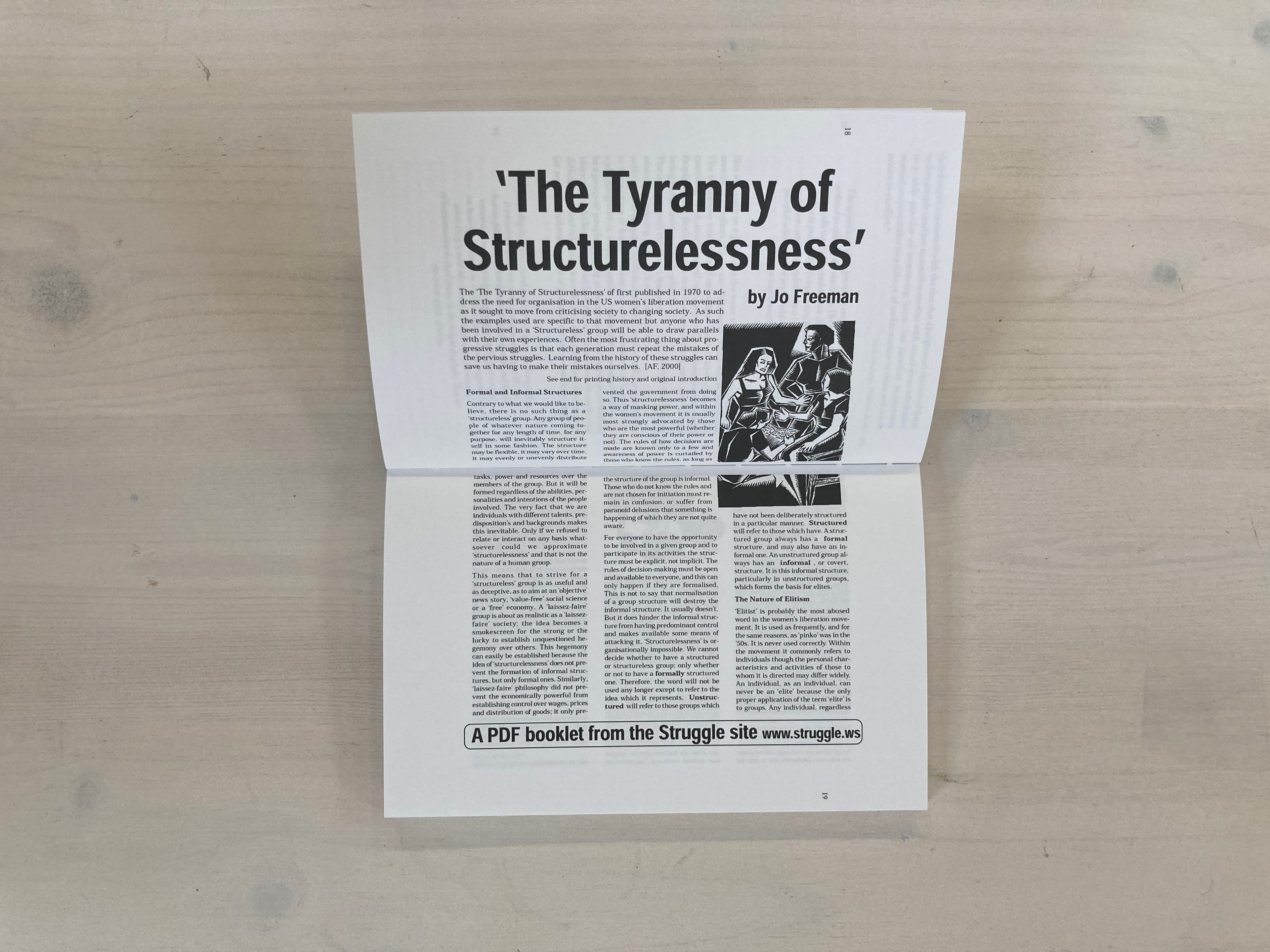
The mistake has been made countless times in the history of self-organization to presume that equality comes through vertical structures of informality, not wanting to use the hierarchical power logics of the politics that are being critiqued. “Contrary to what we would like to believe, there is no such thing as a ‘structureless’ group”, Jo Freeman states in her text, re-printed in this reader. [3] The informal structure always finds its way to build elites. The inevitability of structure makes it necessary to formalize this very structure: titles, roles, working hours, all must be established to give enough framework to then be able to act freely. In her text, Freeman proposes a rotation of roles. What one is best at, is certainly not always what they love doing the most. Sometimes the reason why someone is good at something is not the same reason why they love another task. For example, being good at organizing might come from a specific behavioral pattern based on compulsive control that the person doesn’t wish to make use of as much, since it comes from a place of fear and perhaps even harmful mental conditions. Maybe the person who is extremely good at writing texts, loves hosting guests even more, but cannot cook as well as another member… The group can decide if it has to “operate” as efficient as any enterprise and assign the roles according to who does them best or if other, more caring, parameters of role distribution can exist for them: Is patience and time a resource that the inhabitants of the artist residency have at hand and make space for?
The residents are discussing the dose of authority implemented in their organization. They argue. Some are wishing for the ruling roles to act and decide for them, others wish for as much autonomy and influence as possible. Some conflict-avoiding, some confident in conflict, the groups dynamic systemically positions the actors in the room. Mostly they disagree on the topic of “punishment.”
In groups that claim the same individual identifiers for themselves (such as job descriptions or political orientation), it often comes as a shock that the other has different lived experiences, character traits or wishes/desires. Then, often the mere fact of the other person’s difference is misrepresented as an offense to the others’ own integrity and belonging, which in turn makes them want to protect their dear identity. They see no need to reflect on their own role in this conflict, instead they miscategorize it as abuse, because it threatens their own being so much, which then justifies their cruelty, judgement, and demand of punishment towards the different other. In her book Conflict is not Abuse, Sarah Schulman is concerned with the fact that a heightened rhetoric of threat makes people confuse normative conflict with actual abuse which leads to a wide practice of overstating harm. She therefore recommends mutual accountability in a culture of underreaction to abuse and overreaction to conflict. [4]
The organizers of the group are surprised that their power is ordered as often by the residents. The wish for sovereignty and jurisdiction is demanded more than the discussion of a conflict is practiced. It is interesting how the system we live in, we know, and we complain about is wished for in the small parallel universe of the artist residency. It is hard to unlearn, what one had to enact for so long.
Not everyone in a group has the same tools, backgrounds, abilities, or recourses as others. There are differences. There will be differences. The tolerances towards and amount of conflict, labor, closeness, frequencies, food, sound, smell will vary. In On the Inconvenience of other People Lauren Berlant states that “We cannot know each other without being inconvenient to each other.” [5] There is no such thing as a harmonious pre-existing state without conflict: in a reality that is already conflictual in itself, conflict will eventually come to the surface of human interaction. An expectation of it, maybe even a planning with it, will de-mystify it and make it a productive force. In a group of people working as close together as they do in an artist residency, it could be of help to address the groups’ tolerance to conflict and difference—and with this draw the line where conflict ends and abuse (as well as its inherent logics punishment and consequence) begins.
Zooming in the material walls of this artist residency today, it contains togetherness: The group is meeting to discuss how to get in each other’s way. A couple of minutes into the conversation, one resident suggests to each write a paper on how they want to be treated, what they are triggered by, what they would like to learn. They call it the manual of inconveniences. And there in the bright daylight, they see the other quite clearly.
[1] Saidiya Hartman, Scenes of Subjection, 1997
[2] Lauren Berlant, On the Inconvenience of other People, 2022
[3] Jo Freeman, The Tyranny of Structurelessness, 1970
[4] Sarah Schulman, Conflict is not Abuse, 2016
[5] Lauren Berlant, On the Inconvenience of other People, 2022